Specialization in Medical and Cosmetic Practices
A general digital marketing agency that also happens to take medical clients is not the same as an agency that works exclusively in healthcare. Cosmetic practices have unique considerations, HIPAA compliance in ad tracking, Google's restrictions on before/after imagery, the longer patient decision cycle for elective procedures, the importance of trust signals. An agency without deep medical experience will spend your money learning on the job.
Transparent Reporting and Campaign Access
You should have full access to your Google Ads and Meta Ads accounts at all times. Some agencies keep campaigns in their own accounts, meaning if you leave, you lose your entire campaign history, quality scores, and audience data. Always insist on campaigns being built in accounts you own. Reporting should be weekly, not monthly, and should show the metrics that matter: leads, cost per lead, and conversion rates, not vanity metrics like impressions.
If any of this sounds like your practice, start by checking whether AI search can see your site.
No Long-Term Contracts
Reputable medical marketing agencies don't need to lock you into 12-month contracts. If the results are there, you'll stay. Long-term contracts are often a signal that an agency knows results will be slow and wants to lock in revenue before you can evaluate performance. A monthly rolling agreement with 30 days notice protects you while giving the agency time to optimize.
HIPAA Compliance Knowledge
Any agency running campaigns for medical practices must understand HIPAA as it applies to digital advertising. This means knowing how to configure Google Analytics and Ads to avoid collecting protected health information, using HIPAA-compliant call tracking, and ensuring landing page forms don't inadvertently capture PHI. Non-compliance can result in significant penalties, ask any agency you're evaluating how they handle HIPAA compliance specifically.
Proven Results in Your Specialty
Ask for case studies or references from practices in your specialty. A plastic surgery case study is far more relevant than a general healthcare one. Look for specific numbers: cost per lead, lead volume, revenue generated. Be skeptical of agencies that can only provide vague testimonials without data. The best agencies can point to specific campaigns with specific results.
Proof Before Payment
The strongest signal of confidence is an agency willing to prove its thinking before you pay anything. A free, no-obligation audit of your current marketing, run before any contract is signed, aligns incentives correctly: the agency has to earn the engagement with evidence, not a sales pitch. Medical Marketing Firm offers exactly this, a free AI marketing audit, plus month-to-month terms afterward so the agency keeps having to earn the relationship.
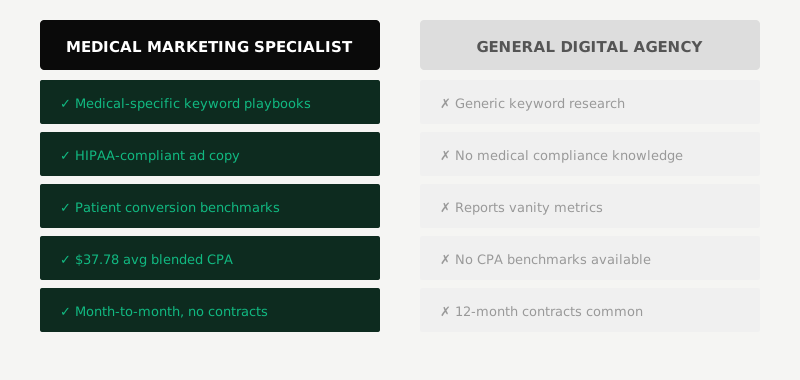
Key differences between specialist medical marketing agencies and generalist digital agencies.
The Account Ownership Question
Before signing with any medical marketing agency, ask this: who owns the Google Ads and Meta accounts? You should always own your accounts, with the agency managing them as an authorized user. If the agency insists on owning the accounts in their name, you lose all historical data, campaign learnings, and ad spend history when you leave. Some agencies use account ownership as leverage to prevent clients from switching. A trustworthy agency is confident enough in their results that they don't need to trap you.
Reporting: What Good Looks Like
A quality medical marketing agency reports on patient acquisition metrics, not just traffic metrics. Your monthly report should include: number of qualified leads generated, cost per lead, cost per booked appointment (if you provide booking data), top-performing keywords and ad copy, landing page conversion rates, and a comparison to the prior period. If a report is full of impressions, reach, and CTR without connecting to actual patient bookings, that agency is optimizing for looking good rather than producing results.
Trial Periods and Onboarding
Ask about the onboarding process in detail. A specialist agency should conduct a thorough audit of your current digital presence, website, existing ad accounts, competitor landscape, and local search rankings, before recommending a strategy. This audit should be free and completed before you sign anything. The quality of this initial analysis tells you everything about the rigor they'll apply to your ongoing campaigns. Agencies that skip the audit and go straight to a contract are templating their approach rather than building a custom strategy.
Get a free AI marketing audit and we'll audit your current marketing for free.
Get My Free AI Marketing Audit →